Advanced PDF Tool
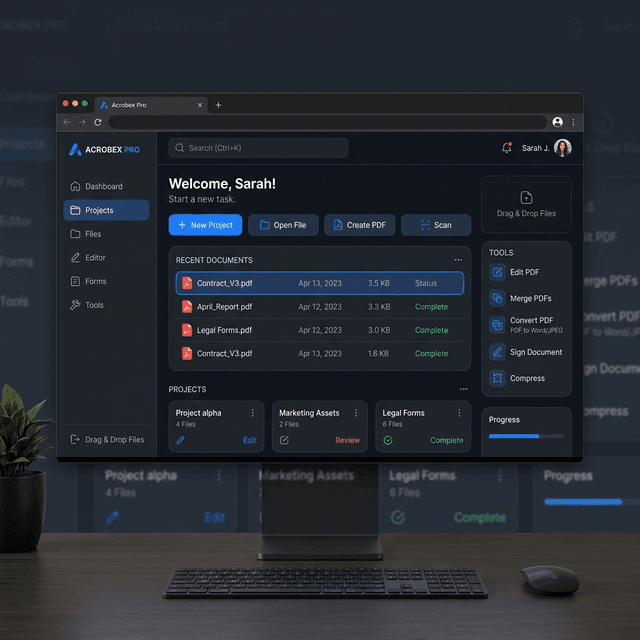
Project Overview
The Advanced PDF Tool is a robust web application designed to simplify complex document manipulations. Built to provide a secure and efficient way to handle files, the platform allows users to manipulate PDF documents—like merging, splitting, and extracting pages—directly through a clean, intuitive interface without needing heavy desktop software.
The Challenge
Handling PDF files programmatically presents significant challenges regarding file size limits, memory management, and processing speed. The primary goal was to build a system that could efficiently process heavy document operations without blocking the main application thread or causing UI latency, while also ensuring consistent deployment across different server environments.
The Solution & Architecture
To solve this, we decoupled the architecture, utilizing a modern frontend and a dedicated, high-performance backend designed specifically for heavy I/O operations and document parsing.
- Frontend: Developed with Next.js, providing a highly responsive, interactive UI that handles file uploads asynchronously and gives users real-time progress feedback.
- Backend Processing: A dedicated Python server powered by FastAPI. Python's extensive ecosystem for document processing allowed for complex manipulations, while FastAPI ensured rapid, asynchronous handling of incoming requests.
- Infrastructure & Deployment: The entire application was containerized using Docker. This approach eliminated the "it works on my machine" problem, ensuring that the necessary Python environments, system dependencies, and Next.js builds ran flawlessly and consistently on the production server.
Key Features
- Secure File Handling: Documents are processed securely in memory, ensuring user privacy and data integrity during the upload and download cycles.
- High-Speed Processing: Asynchronous backend routes powered by FastAPI ensure fast response times even for large documents.
- Consistent Environments: Dockerized architecture allows for easy scaling, reliable deployments, and isolated environment management.
Technical Implementation
A major technical milestone was setting up the communication bridge between the Next.js frontend and the FastAPI backend via robust REST endpoints, and ensuring the Docker network allowed seamless routing between the containers.
# Example: FastAPI endpoint for asynchronous PDF uploads and processing
from fastapi import FastAPI, UploadFile, File, Form, HTTPException
from fastapi.responses import Response
import pdf_processor_lib # Custom Python wrapper for PDF logic

app = FastAPI()

@app.post("/api/process-pdf")
async def process_pdf(action: str = Form(...), file: UploadFile = File(...)):
    try:
        # Read file buffer asynchronously to prevent blocking
        file_bytes = await file.read()

        # Efficiently manipulate the PDF using Python's robust libraries
        processed_pdf = pdf_processor_lib.execute_action(file_bytes, action)

        # Return the processed file securely to the client
        return Response(content=processed_pdf, media_type="application/pdf")

    except Exception as e:
        print(f"Processing Error: {e}")
        raise HTTPException(status_code=500, detail="Processing failed. Please check file integrity.")